
Basics:
Emotion-themed narrative card game
Technical:
PC game, built with Unity engine
Development:
7-person team, January-April 2026
My Contributions:
Narrative design & writing, systems & interaction design
Play it!
https://trulyazul.itch.io/keep-it-real
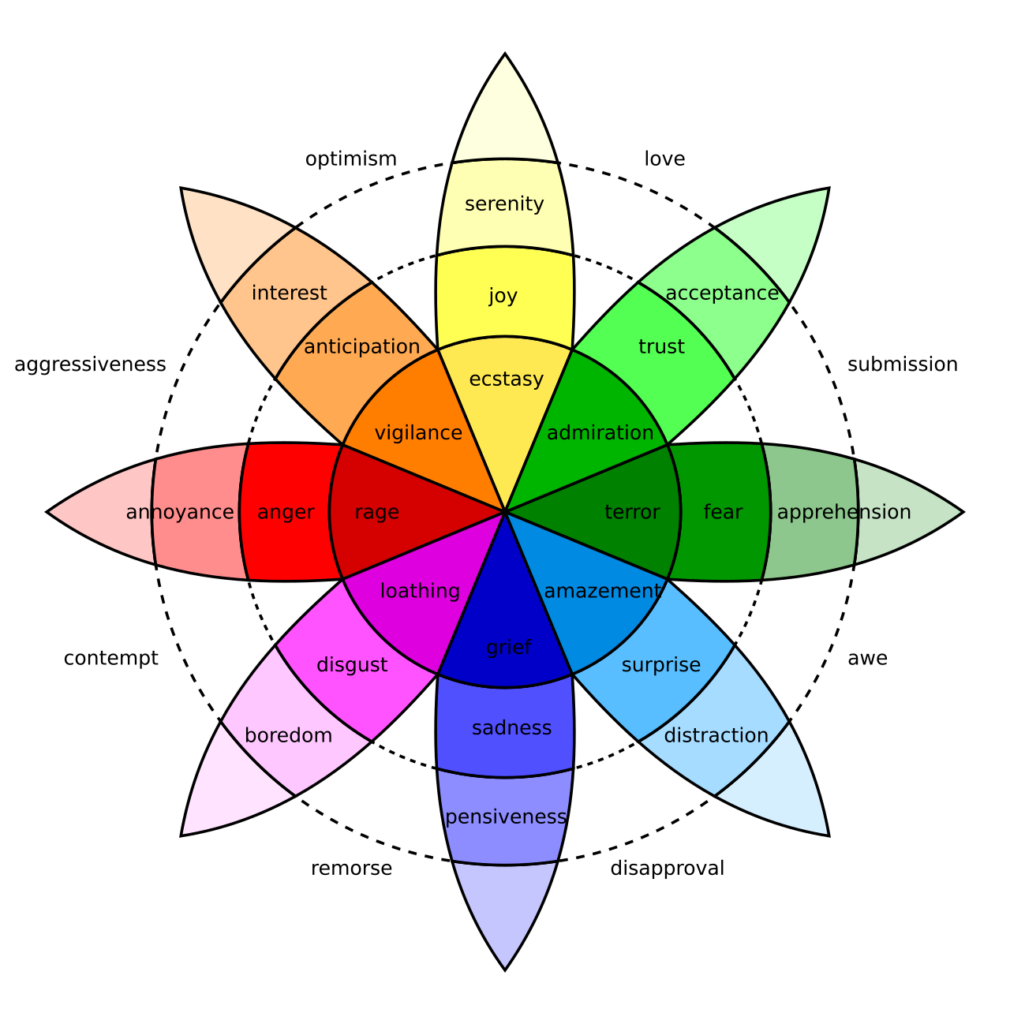
Keep it Real is a narrative-centric card game themed around simulating emotional conversations with your friends. The player takes the role of a college student hosting a party – but several of the guests are going through some kind of stress or emotional turmoil, and the player’s task is to talk them through it. This process is abstracted into a turn-based card game where each card represents an emotional response, corresponding to one of the eight directions on Plutchik’s wheel model:
The gameplay loop consists of:
- Gather information about what your friend is feeling from around the room. This can involve paying attention to the mood of the environment, listening to dialogue snippets from the crowd, and talking to their friends.
- Build your “deck” of emotional responses, based on what you think is the best way to respond to what they’re feeling.
- Go into the emotional “boss fight” with your friend! It’s a turn-based battle against a stylized monster figure, but that monster is symbolic of the conversation you’re really having.
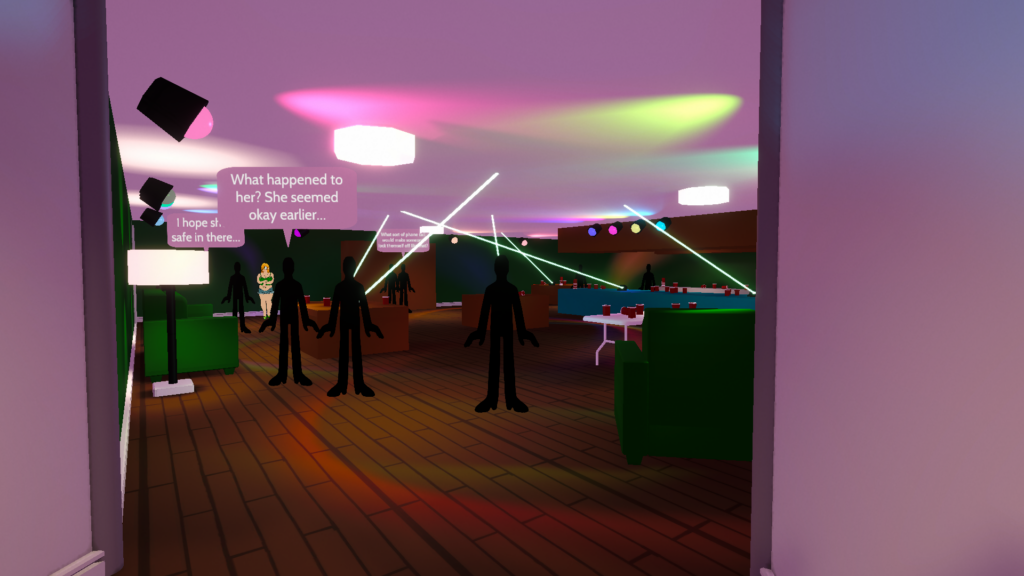
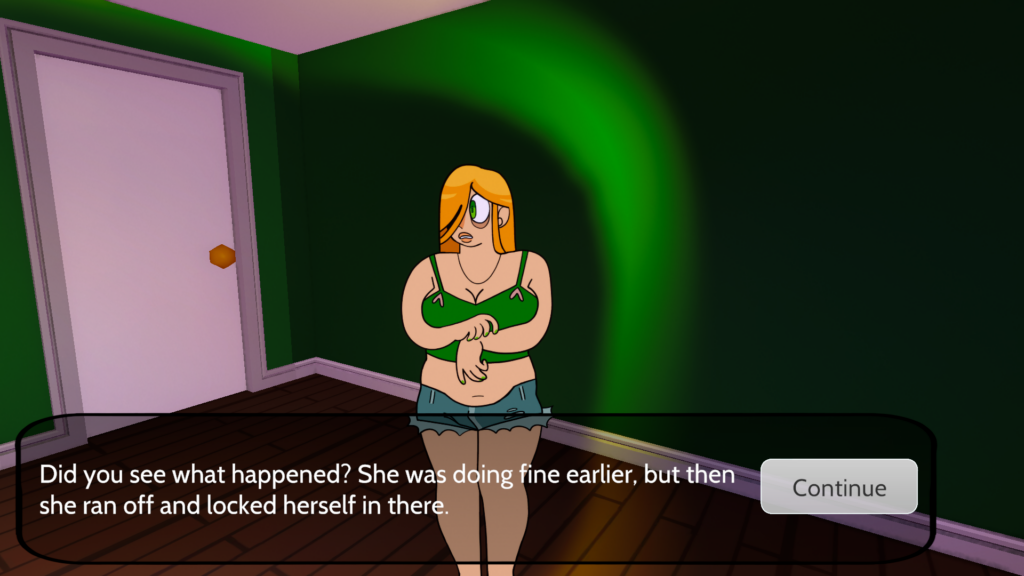
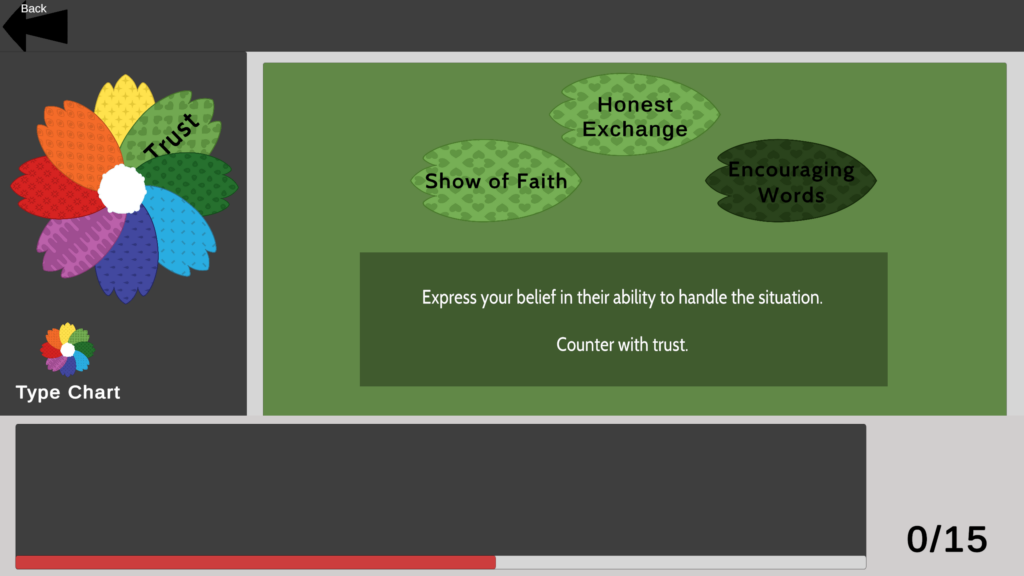
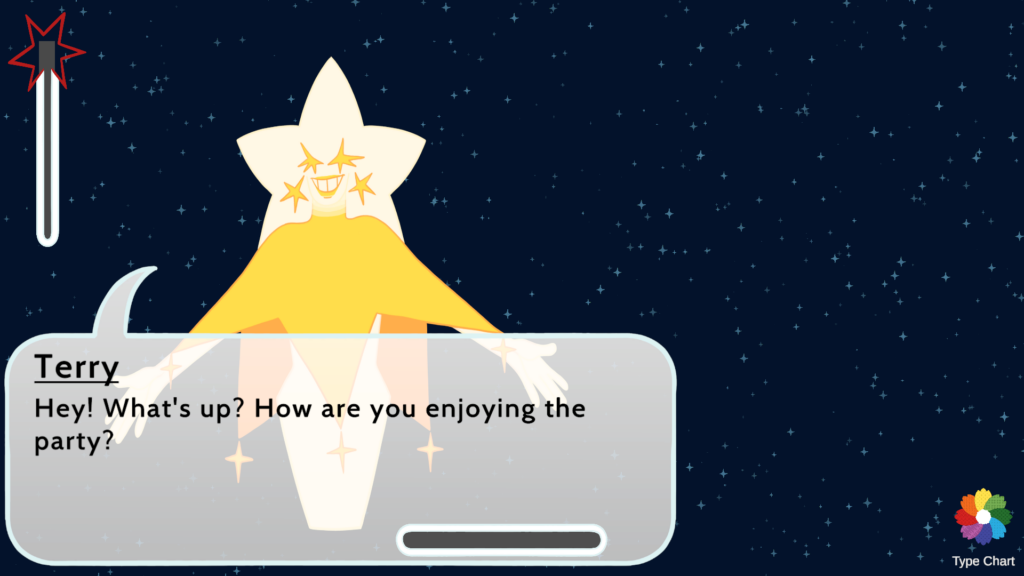
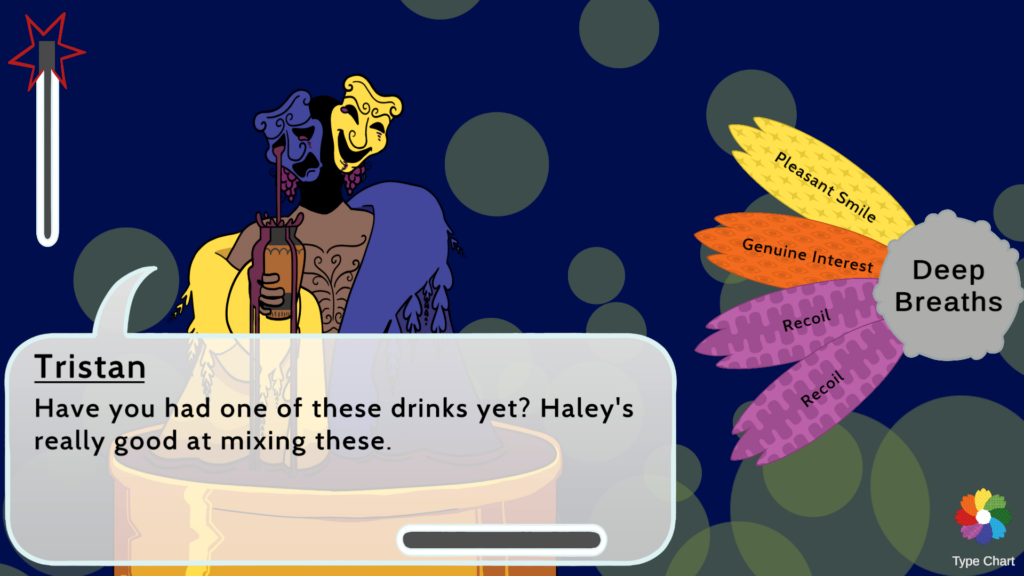
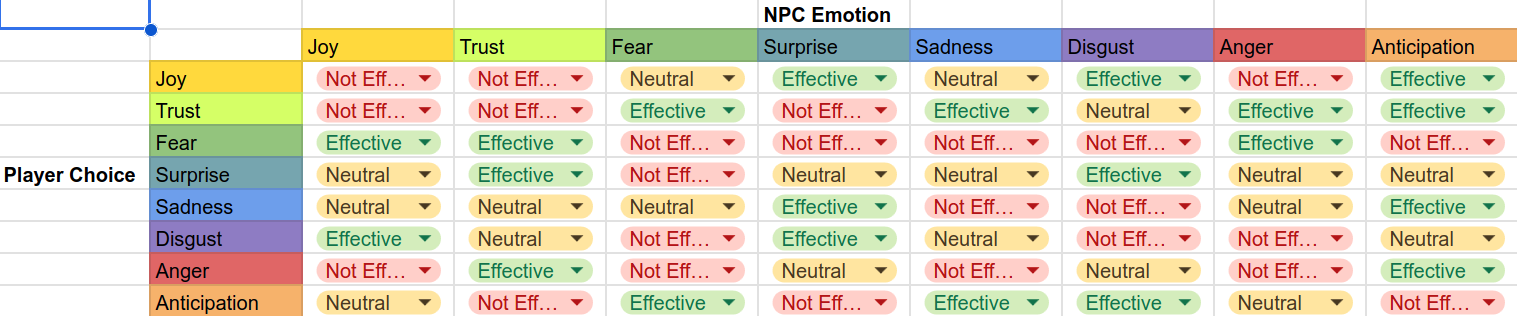
As the narrative and interaction designer on this project, I wrote essentially all of the text in this game (especially the dialogue) and was responsible for everything to do with the interactions between different emotions. My most important design work was the creation of the “emotional type chart”, which governs what emotions are appropriate to use in a specific scenario:
During a tense conversation (i.e. the “combat” sequences), the character you’re talking to will present a different emotion each turn. Each character is themed around one or two emotions that they will return to more often than others, but one of the most important parts of gameplay is reading into each specific line of dialogue and figuring out what emotion it represents.
This immediately leads into one of the core problems this game faced in development. Anyone here who’s a more experienced narrative designer than myself might spot the issue right away, but I was approaching this project as a systems designer and (separately) a writer; this was my first real experience with using narrative design to bridge those two fields. In essence: my task here was to make sure that every line of dialogue in this game would carry one specific emotion that players could pick up on. While still fitting the flow of the conversation, and while making sense to be countered with the effective emotions specified on the above chart. This despite the fact that all players have their own emotional reactions, and will interpret things differently. To write this perfectly was an impossible task.
In hindsight, if I had realized this issue at the start of development, I might have pushed my team to reconsider the premise of this game entirely. But as it stands, I did my best to fulfill this responsibility, and I’m honestly pleased with what I did manage. During our game testing sessions, I did see many players following the intended emotional reactions – in some instances, the majority of players had a mostly correct response – and I count that as a success.
You may notice one quirk of the type chart: why are the four spaces in the top left all “not effective”? What’s the problem with responding to joy with joy, or trust with trust?
My design reasoning there was that the basic setup of this game involves countering the other character’s emotions and trying to calm them down. The implication here is that whatever emotion the character is presenting, that’s necessarily a problem. If a character was joyful for a good reason, they wouldn’t be having this kind of tense conversation with you, would they? Following this logic, I wrote my dialogue such that the characters themed around joy and trust would place those emotions in a negative context. Tristan is presenting as joyful because he’s trying to distract himself from his grief. Daphne has misplaced trust in someone dangerous. Your goal is to get them past that, and being joyful or trusting yourself would only exacerbate those problems.
All that said: if I had had time to expand on this design further, it would have been interesting to introduce situations where the correct response would be to validate a character’s emotion, rather than counter it. I’d have to make a different type chart for that sort of interaction (and design a way for players to pick up on which type of response is appropriate), but it could add further depth to this game’s interactivity and characterization.